How We Manage Quality
PLANNING AND MANAGEMENT
Católica considers three Axes for the development of its strategy: the “Mission” Axis, the “Transversal” Axis, and the “Transformation” Axis.
The Católica Strategic Development Plan 2026-2030 (PDE Católica 26-30) “The Studio University. Promoting wisdom for a new humanity,” inspires the Portuguese Catholic University, based on a new Vision and results from joint reflection with internal and external stakeholders.
The PDE is supported by the “Mission” Axis, with three dimensions that constitute structuring pillars guiding the identity, mission, and institutional development model of the University – Learning and Teaching, Research and Innovation, and Responsibility and Impact, and by the “Transversal” Axis across all University activity, with the dimensions of Global Positioning and Sustainability.
The Católica Quality Plan 2026–2030 (PQ Católica 26–30) includes a set of Strategic Projects that enhance and drive the implementation of the strategy defined in the SDP Católica 26–30. The Strategic Projects included in the QP Católica 26–30 operationalize the purposes of the Commitments and Strategic Priorities that have been defined.
The Strategic Priorities guide the “Transformation” Axis, which includes three dimensions structuring the University’s specific vision of transformation, as a global education institution, and its own model for the development of knowledge: Studio University, Integral Ecology, and Campuses of the Future/Campus Veritati.
Católica’s Agenda for Sustainability is a University plan and commitment that aims to strengthen Católica’s Global voice in the guidance towards the common good.
Católica is committed to promoting sustainable development and protecting the “Common Home”. It thus works to make a contribution that is consistent with the 17 Sustainable Development Goals (SDGs) and the UN 2030 Agenda, in light of Pope Francis’ Laudato si’ and Fratelli tutti encyclicals on Integral Ecology and Social Friendship, respectively.
In its Strategic Development Plan Católica considers three types of dimensions in the development of its strategy:
“Mission” dimensions: these integrate the macroprocesses connected to Católica’s Mission of Learning and Teaching, Research and Innovation, and Responsibility and Impact;
“Transversal” dimensions: these integrate macroprocesses that, due to their strategic nature in the 2026-2030 context, require a particular institutional focus and must cut across all other: Global Positioning and Sustainability.

The Macroprocess Approach
The Católica QS is therefore composed of six macroprocesses: the five detailed in the SDP plus the Governance and Improvement Macroprocess.
The Governance and Improvement Macroprocess integrates the institutional commitments in terms of Quality Policy, and establishes the standards for planning, monitoring and reviewing all QS processes to ensure proper monitoring of the system and guarantee continuous improvement.
For each macroprocess, there is a Policy (consult Documents) which contains guidelines or principles for decision-making and action, leading to the fulfillment of the defined objectives.
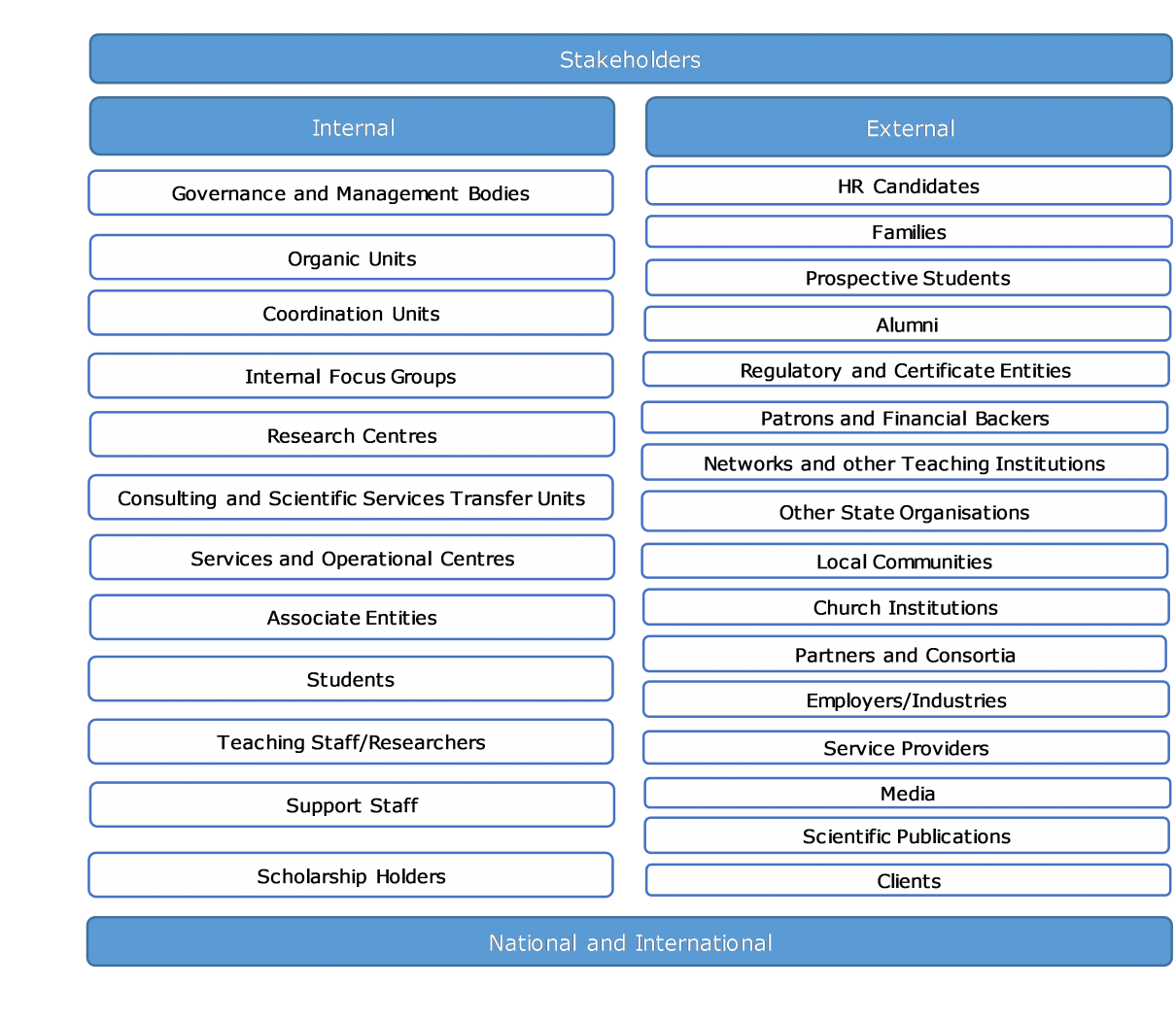
Stakeholders
Católica’s Stakeholders are identified in the picture below. These Stakeholders intervene at different organizational and regional levels with varying scope, depth, and levels of impact. The University’s activities are based on Stakeholders’ involvement in the QS, which encompasses mechanisms to assess their needs, expectations, and satisfaction levels. Católica is concerned with improving the ways and frequency of Stakeholders’ involvement in the Católica QS. These, while being diverse, must take into account organizational levels and processes.
Policy for the Identification and Engagement of Católica Stakeholders