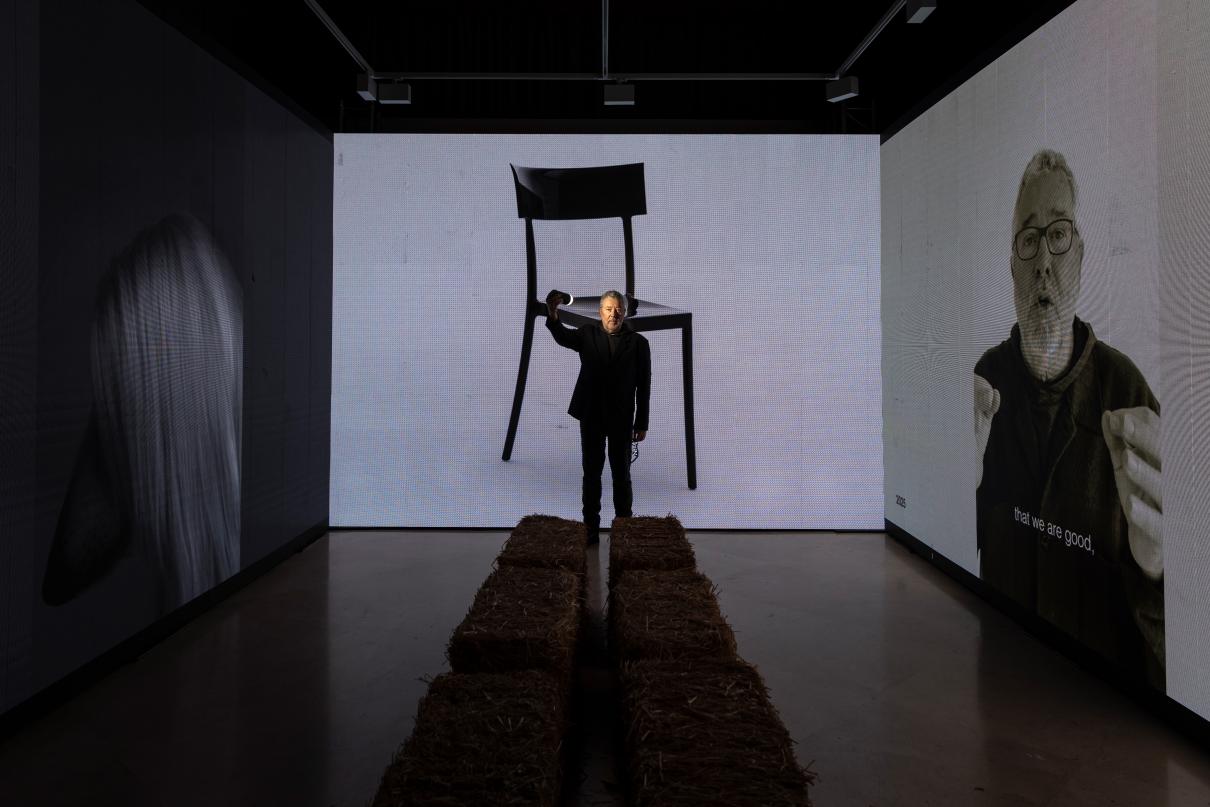
Philippe Starck exhibition on display at Universidade Católica in Lisbon
The Amélia de Mello Foundation Gallery, at the headquarters of Universidade Católica in Lisbon, is hosting an exhibition dedicated to the work of French designer Philippe Starck, conceived and curated by the author himself.
Entitled ‘Philippe Starck, The Duty of Creativity’, the exhibition brings together objects and videos and invites visitors to enter the universe of one of the most visionary and acclaimed creators on the international contemporary scene, revealing the philosophy underlying his creation.
“Creativity should not be restricted to the arts, design or literature. Plumbers, teachers and firemen can, and should, be creative too,” says Philippe Starck, referring to the theme of the exhibition. “For me, creativity is something that emerges in us, coming from nowhere, from a magma that exists somewhere in our heads and which, at certain moments, produces visions and intuitions. The more oblique these intuitions and products are, the stronger they will be. Then comes enormous rigour and work. As far as I am concerned, an idea — whatever it may be — takes between five and forty years to mature. I am merely the printer of the ideas I visualise in my brain. This is what creative work means to me — it is a challenge we face every day, within ourselves," he continues.
Recently awarded an honorary doctorate by the Universidade Católica, Philippe Starck stands out for his inventive and multifaceted work, centred on the principle that creation, regardless of its form, should improve the lives of as many people as possible. This philosophy has established him as one of the pioneers and central figures of so-called “democratic design”. Throughout his prolific career, Starck has developed projects in multiple fields, ranging from everyday objects, such as furniture, his iconic citrus juicer and electric vehicles, to architecture, namely hotels and restaurants that seek to establish themselves as stimulating spaces. His work also extends to areas such as naval and space engineering, including the design of mega-yachts and space habitation modules.
The exhibition is part of the Cultura@Católica initiative, which places culture, art and creative expression at the centre of university life, promotes the encounter between science and art, and seeks to encourage creativity in the production of knowledge.
By sharing his personal vision and creative journey, Philippe Starck offers us not only objects and ideas, but a bold, free way of thinking that is deeply engaged with the human condition. At a university like Católica, art and creativity are not peripheral, they are essential. They feed curiosity, sharpen critical thinking and open up spaces where knowledge and imagination meet. Creativity connects disciplines, encourages dialogue and reminds us that education is not just about understanding the world, but also about shaping it in times of uncertainty and transformation," said Isabel Capeloa Gil, President of the Universidade Católica, at the opening of the exhibition.
‘This exhibition serves a vast academic community, thousands of students, hundreds of teachers and researchers, and the many people who visit us,’ said the gallery's director, Paulo Campos Pinto, on the same occasion.
With free admission, the exhibition can be visited every weekday between 2pm and 5pm on the first floor of the João Paulo II University Library building. No booking is required, but if you wish, you can schedule your visit and obtain additional information by emailing cultura.sede@ucp.pt.
‘Philippe Starck, The Duty of Creativity’ is sponsored by Delta and supported by the Amélia de Mello Foundation, Caixa Geral de Depósitos and Innovarisk Iberia.