

Cristina Luísa Silva: "I prefer getting to know people over places."
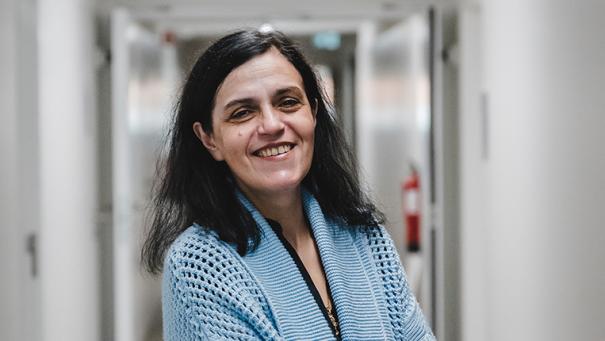
Cristina Luísa Silva is a professor and researcher at the Faculty of Biotechnology at Universidade Católica Portuguesa. She developed a natural talent for Mathematics and holds a degree in Chemical Engineering, as well as a PhD in Biotechnology from the Faculty of Biotechnology, with a specialization in Food Science and Technology. She has dedicated her life to research, teaching, and network collaboration. In 2022, she was internationally recognized in the field of food engineering and technology, being elected a Fellow of the International Academy of Food Science and Technology. She loves to travel and is always open to discovering and trying new things: “I get excited about diving into new fields, I enjoy novelty.”
As a child, which subjects excited you the most?
Mathematics! I only didn’t pursue Mathematics at university because I thought I didn’t want to be a teacher, and back then we didn’t have the kind of career guidance we do now. I ended up choosing Chemical Engineering. An older cousin of mine was studying it, and I thought it could also be a good path for me.
Do you have a very quantitative and analytical profile?
Yes, and I think it’s genetic. My whole family shares that profile. We’re mostly engineers: mechanical, chemical, electrical, and computer engineers. Math comes very naturally to us.
You’ve dedicated your life to the food industry. When did you first get involved in this area?
It happened during my master’s degree here at the Faculty of Biotechnology, where I also completed my PhD in Biotechnology with a specialization in Food Science and Technology. At that time, I had already started teaching. That’s when I crossed paths with this field, but to be honest, I often think I could’ve gone into many other areas. I see myself among some of today’s students who feel a bit lost. I like to tell them that it’s not a problem. Even now, I still have many interests. The path unfolds as you go…
Would you have been happy in other fields?
I think there were many fields I could have chosen. What I always tried to do was give my best so that I could have the freedom to choose, that’s what I cared about most. Even now, I’m fascinated by many other fields, and I hope to contribute to them someday. I get excited about diving into new areas; I love the feeling of something new. I like to reinvent myself. Sometimes people feel sad about losing a position or role. I see it as an opportunity.
What subject do you teach? You’ve also been very involved in international projects and networks…
My field is very multidisciplinary. I teach Advanced Food Technologies, Applied Particle Mechanics, Fluid Mechanics, and Applied Transport Phenomena. I coordinated an Erasmus thematic network for nine years. This European project had over fifty member countries at one point. I dedicated a lot of time to its management and growth.
What is your view on the current phenomenon of Artificial Intelligence?
It interests me but it's not new to me. In the 1990s, I worked on a project for a company where I mathematically described a phenomenon. I established a relationship between inputs and outputs and converted it into a formula, a single mathematical expression that summarized tons of data and simulations. I often say I “put the elephant through the eye of a needle,” because I organized thousands of simulations into one model. Someone once told me, “That’s artificial intelligence.” And I realized that yes, I was already doing that in the 1990s.
How does AI help you in your day-to-day life?
It helps me organize ideas, structure thoughts, and write emails. I tell my students to use AI critically. If we’re using AI in our daily lives, it’s to have more time to think and reflect critically. No machine can do that for us. It is essential to give our students the right tools. Nobody calculates things by hand anymore; we use calculators. It doesn’t make sense to walk to Paris when we have airplanes. Nowadays, AI allows us to reach places we couldn’t have otherwise. Recently, I heard in a training session that we’re in the middle of a revolution and don’t even realize it. The truth is, we’re already using AI without even noticing.
In 2022, you received international recognition in food engineering and technology through your election as a Fellow of the International Academy of Food Science and Technology.
I always feel too small to have been the one chosen. I was nominated for my contribution to the international community and my commitment to building networks. Interestingly, I got into that field by accident, it wasn’t something I had planned. But it happened, and I ended up dedicating a lot to creating networks with dozens of countries around the world.
You love to travel…
Very much. I always wanted to travel, and research made that possible. Today, everyone travels, but when I started my degree in 1983, traveling was more difficult, but I had that desire. I wanted to meet other people and learn how they lived.
A memorable trip?
Beijing, China. We went to the Great Wall. It was a very distinct experience. I also enjoyed Iceland, and I love Latin America. Every time I go there, I feel a special energy, as if in another life I had been from there. Maybe it’s the energy of the people. I prefer getting to know people over places. Perhaps I get to know the places through their people…
And in Portugal, what’s your favorite place?
The northern sea. Our sea is wild. I love the smell of salt air. We, Portuguese people, come from the sea.
Pessoas em Destaque é uma rubrica de entrevistas da Universidade Católica Portuguesa, Campus do Porto.