The Católica Learning Innovation Lab (CLIL) team has recently visited three international contexts of excellence in terms of pedagogical innovation in higher education: Stanford University (United States), University College London, and the University of Kent (United Kingdom).
The objective? To create partnerships with international experts in pedagogical innovation in higher education field and identify transformative educational strategies already tested with in these contexts, that can be applied at the Universidade Católica Portuguesa.
At Stanford University, the teachers Ângela Azevedo, Armanda Gonçalves, and Eva Dias de Oliveira from Universidade Católica Portuguesa had the opportunity to meet the Center for Teaching and Learning operating model at Stanford University and its counterpart at Stanford Business School.
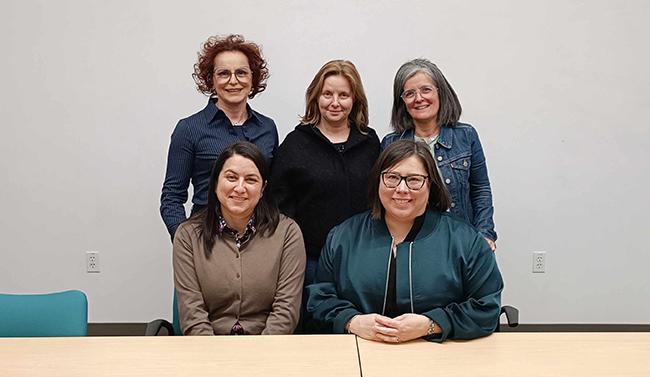
Photo: UCP professors Ângela Azevedo, Armanda Gonçalves, and Eva Dias de Oliveira, with Gloriana Trujillo and Cassandra Volpe Horii, at Stanford University
The meetings had an atmosphere of sharing and openness. As a result, it was possible to collect "in loco information about policies and models of teacher training and successful teaching-learning models, which may be implemented in UCP," explain the CLIL teachers.
The visit also allowed the identification of common challenges, such as, for example, the recognition by the academic community of the relevance of a unit dedicated to pedagogical qualification and innovation in higher education. "These structures of pedagogical innovation and qualification should present themselves to the community as agents that seek to promote partnerships and not as disciplinary agents," they stress.
Immersion in the good practices of two UK Universities
In March, the CLIL team went to London, where they met with the management of the Arena Centre for Research-based Education, University College London (UCL), and the Centre for the Study of Higher Education, University of Kent.
Diana Soares, Paulo Dias, and Marisa Carvalho, professors at the Universidade Católica Portuguesa, got to know better the strategy of the two universities and the two centers focused on improving pedagogical innovation practices.
"These visits were truly inspiring. We realized that the pedagogical practices and innovation challenges are similar in international higher education institutions, but there is already a lot of work done. We can thus experiment/test some strategies already tested in these universities. Still, we can also share what we do in this area at the Universidade Católica", say the teachers.
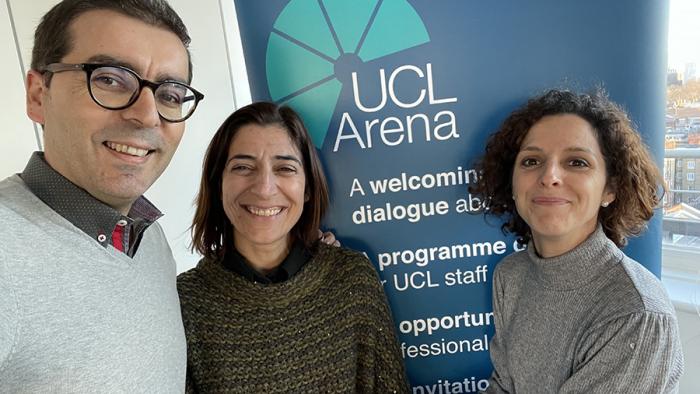
Photo: Paulo Dias, Marisa Carvalho, and Diana Soares, at University College London
About CLIL
CLIL was created to identify, test, and explore innovative pedagogical approaches. It counts with the collaboration of faculty, researchers, and students at UCP and with the support of strategic partners from business and civil society.
This Lab is funded by the project "Skills 4 PósCOVID - Competências para o futuro no Ensino Superior" [Competences for the future in Higher Education], which is financed by Portugal 2020, in the frame of the PO CH – Programa Operacional Capital Humano [Human Capital Operational Program], through FSE – Fundo Social Europeu [European Social Fund].
Laboratório de Inovação Pedagógica | CLIL